Practical guide
Missing Clothing Care Label? A Cautious Cleaning Decision Checklist
Look for remaining care information, identify the exact garment and check its lining, trim and alterations before choosing a complete cleaning and drying process. Use the information sheet and six cases to separate verified instructions from assumptions. Cold water, a hidden test or a drycleaning appointment does not settle every unknown.
Start with information, before the garment gets wet
If a clothing care label is missing, first try to recover instructions for the exact item. Keep it out of a mixed laundry load while you check. A missing tag is an information problem: it does not tell you that the garment is washable, drycleanable or safe for a gentle cycle.
Some missing-label decisions are straightforward once a readable instruction is found elsewhere. Others remain uncertain because the fabric, lining, decoration or finish cannot be identified. This checklist helps you recognize the difference and gives a maker or cleaner a useful description.
You do not need to prove every material at home. Write unknown where evidence is missing. Avoid destructive identification experiments such as burning fibers or cutting a sample from the garment. A familiar feel, a retailer’s similar photo or another person’s successful wash can be a lead to investigate, but none supplies complete care instructions for this item.
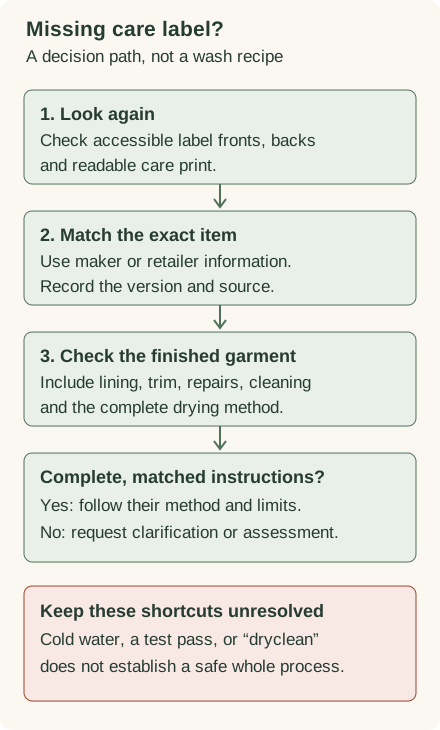
Check whether the instructions are actually missing
Inspect the front and back of accessible labels, including a label carrying fiber composition. Look for readable care print inside the item and any care information saved from its packaging or original hangtag. Do not unpick seams or damage a lining to search.
The US Care Labeling Rule, section 423.6(a), requires care labels to be seen or easily found when the product is offered for sale. If packaging, display or folding hides that information, it must also appear on the outside of the package or a hangtag. Saved packaging can therefore be a useful place to check. If the garment came in a set, confirm that any instruction you find applies to the exact piece rather than assuming every component has the same care.
Photograph what remains before repeated handling makes faded text harder to read. Keep the whole instruction, including restrictions, rather than saving only a temperature or one washing symbol. A partly readable label is incomplete evidence. For example, “hand wash” with an unreadable drying line leaves a question you still need to answer.
If you recover symbols, identify the complete instruction with an appropriate symbol guide. Do not reconstruct a vanished warning from the absence of a mark on a torn label. ACI’s laundry basics and fabric-care symbol guide includes distinct wash, bleach, drying and ironing instructions.
Ask for instructions that match the exact version
Use a receipt, order history, style number and remaining brand information to contact the manufacturer or original retailer. Include photographs of the whole garment, its remaining labels and relevant trim. Explain whether it has been altered, repaired, printed or dyed since purchase.
A useful request is: “Can you confirm the complete care instructions for this style, color and version, including its lining and decoration? These photographs show the item and what remains of the labels.” Ask for the washing or cleaning method, drying, ironing and any process restrictions that affect components.
Save the reply with its date and the details used to match the item. If the responder supplies a generic fabric chart or cannot identify the version, keep that limitation in your record. A similar garment from a newer season may have a different finish, lining or decoration. Matching the brand and silhouette alone is not enough.
A manufacturer may be unable to recover an old item’s records. That outcome is useful information too: you have reached the limit of that route. The next step can be an experienced cleaner’s assessment of the actual garment, rather than more confident guessing from unrelated listings.
Make an information sheet for the finished garment
Download the missing-care-label information sheet. Record what is printed or directly observed, what came from a matched source, and what remains unknown. This distinction makes the sheet useful even when you cannot identify the fiber.
| Field | What to record | What not to infer |
|---|---|---|
| Item identity | Brand, style or item number, approximate purchase date, size and color. | A visually similar listing is the same garment. |
| Remaining labels | Photograph both sides of every accessible label and any readable print. | A fiber label is the complete care instruction. |
| Outer material | Record the printed composition, or write unknown. | Touch proves the fiber or finish. |
| Other components | Lining, interfacing, padding, elastic, trim, coatings and attached decorations. | The outer fabric controls every component. |
| Construction and condition | Knit or woven appearance, loose seams, damage, fragile areas and alterations. | A small hidden test assesses the garment’s strength. |
| Current problem | Stain location, what caused it if known, odor or ordinary wear. | Every mark needs a soaking treatment. |
| Care history | Previous method, product, drying and result for this exact item. | One earlier success guarantees the next treatment. |
| Recent changes | Repairs, new print, added trim, dyeing or previous damage. | Instructions for the original item cover later changes. |
| Recovered instructions | Save the exact text, source, date and how the item was matched. | An online fabric-care chart is item-specific evidence. |
| Unresolved limits | Water, cleaner, agitation, drying, ironing or professional-process questions. | Cold water or drycleaning answers every uncertainty. |
| Next decision | Follow matched instructions, request clarification, or seek an assessment. | An unanswered question is a pass. |
The rule’s section 423.6(c)(3) addresses evidence for each component together with the garment as a whole. Information about the outer fabric alone leaves its lining, coating or attached decoration unresolved. That is why “100% cotton” or “polyester outer” cannot settle every care decision for a lined, coated or decorated item.
Describe the current problem separately from the material. A fresh stain on one area, an odor after storage and an item needing ordinary cleaning are different observations. Tell a cleaner about products already applied and any earlier heat exposure. Those facts help them assess the item without having to guess what happened before it arrived.
Choose the next action from the evidence you have
| What you have | Next useful action | Keep this limit |
|---|---|---|
| Complete, readable instructions for the exact finished item | Follow the stated method, drying and warnings; check the actual product and machine instructions too. | Recent alterations or damage may need clarification. |
| A likely match, incomplete reply or conflicting instructions | Request the missing information and identify the version or component in question. | Do not fill gaps from a general care chart. |
| Unidentified components, fragile condition or an irreplaceable item | Seek an appropriate professional assessment before applying a product or immersing it. | An assessment can still conclude that a proposed process is unsuitable. |
| No reliable match or complete care guidance | Keep uncertainty explicit and discuss possible methods and damage risks with a suitable cleaner. | There is no universally safe wash recipe established by missing information. |
Plan the whole process before starting: cleaning, rinsing where applicable, support while wet, drying and finishing. If you have a washing instruction but no permitted drying method, ask for clarification. A low-heat dryer setting is still a drying choice with consequences.
ACI recommends following garment care instructions and choosing the appropriate washer and dryer settings. Product directions answer another question: how that particular cleaner is prepared and used. A product advertised for a fiber type does not supply missing instructions for every finished garment containing that fiber.
If an item is needed immediately, using another suitable garment while the question is resolved can be cheaper than rushing an irreplaceable item into a speculative treatment. Cost or urgency may affect your personal decision, but neither changes what has been established about material compatibility.
Recognize shortcuts that do not resolve missing information
“Cold water is always safe.” Temperature is only one part of a process. Water compatibility, agitation, products, trim and drying remain separate questions. An unknown garment has not become approved for immersion because you lowered the temperature.
“A hidden test passed.” A small test can reveal a particular change under particular conditions. It does not assess every component, structural weakness or whole-garment process. Our colorfastness guide starts only after the item and proposed treatment are known to be suitable for that test. Use it for that narrower task once the relevant instructions are available.
“Drycleaning avoids all the risks of water.” Drycleaning is also a process whose suitability needs checking. Section 423.6(b)(2) describes solvent instructions and process warnings, including a no-steam example. Ask a cleaner to assess the actual item and its components rather than assuming that booking drycleaning resolves the missing label.
Pause before DIY when instructions conflict, attached components remain unidentified, the garment is fragile or irreplaceable, or you cannot determine whether the proposed product and complete process are appropriate. Existing weakness, damage or an uncertain alteration is also a reason to get advice first. A test itself can leave a mark, so “try a hidden place” is not a consequence-free fallback.
Keep cleaning products separate. Do not mix products or improvise a stronger treatment to compensate for uncertainty. This checklist’s next step is obtaining information or an assessment, rather than cycling through household chemicals until something appears to work.
Six cases: which information is enough?
These invented cases show how to use the checklist. They describe evidence and decisions, not tested outcomes for real garments.
Case 1
You find readable care instructions on the back of a fiber label inside the exact shirt. They specify hand washing and flat drying. What should you record?
Show answer and explanation for case 1
Save the complete instructions and use their method and restrictions for this shirt.
The problem was an overlooked label, rather than confirmed absence of instructions. Record both the wash and dry method, along with any warnings about bleach, ironing or trims. A hand-wash instruction does not become permission for a machine cycle merely because it is called gentle. Here the case supplies readable instructions for the exact shirt; save their complete wording rather than relying on the label’s position. If any wording is partly erased, keep that part unresolved instead of filling it from a different garment.
Case 2
A jacket’s surviving tag identifies the outer fabric as polyester. The lining and bonded decoration are unidentified. Is that enough to select a wash cycle?
Show answer and explanation for case 2
No. Find instructions for the finished jacket or seek an assessment of all its components.
A composition label identifies material; it does not specify the complete cleaning process. Section 423.6(c)(3) addresses component evidence together with evidence for the garment as a whole. Even an accurate fact about the outer fabric leaves those other components unresolved. Do not turn a general polyester care chart into instructions for this jacket. Photograph the tags, lining, seams and decoration, then give the maker the style number and color. If a cleaner assesses it, ask about the finished garment and any required process changes.
Case 3
A secondhand sweater feels wool-like. A friend recommends cold water because that worked for their sweater. What does that experience establish?
Show answer and explanation for case 3
It establishes a result for the friend’s item, not verified care instructions for yours.
Your sweater’s composition, finish, construction and condition may differ. Calling it wool from touch also leaves the identification uncertain. The advice does not supply a permitted detergent, agitation level or drying method for the finished item. Record what you actually know, then look for an identifiable style or ask an experienced cleaner. A small hidden water test would still be a treatment of your item and would not establish that immersion is suitable for all its parts.
Case 4
A retailer page shows a dress with the same silhouette and says dryclean. Your dress has different beads and no readable style number. Have you recovered its instructions?
Show answer and explanation for case 4
No. Keep the listing as a possible lead and verify the exact version before relying on it.
A matching shape or brand is not enough when trim differs. The beads on this dress differ from those in the listing, so the listing does not establish a compatible process for this finished item. The rule’s evidence provision considers components together with the whole garment. Do not instruct a cleaner to use the listing’s process as if the identification were settled. Share the uncertainty, photographs and any receipt with the retailer or maker. If exact instructions cannot be recovered, the next useful action is an assessment of this dress, including the beads.
Case 5
You have washed a cotton-looking shirt several times without an observed problem. A new decorative print was added after the last wash. Does the old history cover the new print?
Show answer and explanation for case 5
No. Record the previous results, then obtain the print’s restrictions and check their fit with the shirt.
History can help identify what happened under a particular method. The added print changes the item being assessed. Write down when it was added and ask the decorator for care information that applies to their work. Both the garment and alteration need compatible care. Do not invent a dryer setting from earlier success before the print existed. If their instructions conflict, ask for clarification rather than combining a wash method from one source and a drying method from another.
Case 6
The maker identifies your exact item and supplies a washing instruction, but the reply gives no drying information. Should you fill the gap with a low-heat dryer cycle?
Show answer and explanation for case 6
Ask for the drying method and remaining restrictions before choosing the complete process.
Cleaning decisions continue after washing. Section 423.6(b)(1)(ii) treats drying as a distinct element of washing instructions, and ACI includes separate drying symbols such as flat, line and do-not-tumble-dry. A low setting is still tumble drying and cannot be inferred from silence in an incomplete reply. Save the washing information as evidence received, mark drying unresolved, and request the complete care guidance. Planning where and how the item will dry is part of the decision before it becomes wet.
Keep recovered instructions for the next clean
Once complete instructions are recovered, save their text or a clear photograph in a private garment note. Include the item identifier, information source and date. Keep restrictions with the method so “hand wash” does not become a remembered instruction stripped of its drying requirements.
After alterations, new decoration or damage, check whether the saved information still covers the item’s condition. Record a permitted cleaning result as an observation about that method and item. It can be useful history; it is not proof that every other cleaner or future procedure will work.
If you consult a cleaner, bring the information sheet and say plainly that the care label is missing or incomplete. Ask what they can assess, which components are uncertain, what process modifications they propose and what damage remains possible. Useful advice may include postponing cleaning or avoiding a particular process.
The completed checklist should leave you with one concrete next action: follow complete matched instructions, request a specific missing detail, or obtain an assessment. It is successful when it prevents a guess from silently becoming the garment’s new care instruction.
Sources and further reading
- eCFR: 16 CFR Part 423, Care Labeling RuleSection 423.6: accessible care information at sale, separate drying requirements, drycleaning process warnings and evidence for components together with the garment as a whole.
- American Cleaning Institute: Laundry BasicsGarment instructions, sorting by care requirements, component checks and separate washing, drying and ironing symbols.
Uncertain white material on a dark garment?
After recovering the item’s care information, separate loose fibers, powder-like deposits, pills and changed color before selecting treatment. The observation record keeps the product and machine details with the question.