Practical guide
Tumble Dry or Air Dry? A Care-Label Decision Guide
Read the complete drying instruction before choosing a dryer program or rack. Compare the label’s tumble permission, heat and process limits with its flat, line, drip or shade requirements. Use an original decision map and eight explained cases to avoid treating every air-dry arrangement as interchangeable.
Tumble dry or air dry: start with the complete instruction
Choose the drying method from the garment’s complete care instructions. If tumble drying is permitted, match the specified heat and process to the actual dryer. If the item requires flat, line, drip or shaded drying, keep that particular arrangement. Air dry is a broad description; it does not make hanging and flat drying interchangeable.
A do-not-tumble-dry instruction is not overridden by a low-heat or Air Fluff setting. A missing or damaged label leaves a different problem: recover the exact item’s instructions before choosing its whole cleaning and drying process. Use the missing-label checklist for that information task.
Plan the drying place before washing, especially for an item that needs support while wet. This guide explains label decisions and supplies eight practice cases. It does not prescribe one method for every cotton shirt, wool sweater or synthetic garment, and it does not report shrinkage tests performed on particular products.
Read the drying symbol and keep its system visible
A square containing a circle refers to tumble drying; a circle alone belongs to a different care category. In the ISO/GINETEX system, horizontal or vertical lines inside the square distinguish natural-drying arrangements, and an oblique mark adds shade. Read the modifier with the method, rather than treating one mark as the complete instruction.
The table describes recognizable features in words. For the actual symbol artwork and variations, open GINETEX’s ISO 3758:2023 overview. Its mild and normal tumble processes should not be mixed with a different chart’s low/medium/high categories. The ACI guide lists several drying categories too. Identify which system and written directions apply to your garment.
| Label feature | Meaning | Action | Common misreading |
|---|---|---|---|
| Square containing a circle | Tumble drying | Read its heat limit and any additional process instruction. | A circle by itself concerns professional cleaning, not a home dryer. |
| One dot inside the circle, in the ISO/GINETEX system | Mild tumble drying with reduced thermal action | Select an appropriate low-temperature process using the appliance guide. | A button named Delicate is not enough to identify its temperature or movement. |
| Two dots inside the circle, in the ISO/GINETEX system | Normal tumble drying | Follow the stated normal process and the rest of the garment instructions. | Do not use a different regional chart to rename this symbol medium heat. |
| Cross through the square-and-circle symbol | Do not tumble dry | Use the specified non-tumble method; clarify it if incomplete. | No-heat tumbling still uses the drum. It does not cancel the prohibition. |
| One vertical line in the square, in the ISO/GINETEX system | Line drying | Arrange the item on an appropriate line or support as its instructions require. | Natural drying is not automatically permission to hang every wet garment. |
| Two vertical lines in the square, in the ISO/GINETEX system | Drip line drying | Keep the specified drip-drying process when arranging the item. | Do not replace drip instructions with an invented spin or wringing step. |
| One horizontal line in the square, in the ISO/GINETEX system | Flat drying | Support the garment flat, keeping its intended shape. | A hanger is not a flat support, even if both methods use room air. |
| Two horizontal lines in the square, in the ISO/GINETEX system | Drip flat drying | Use the specified flat drip-drying arrangement. | A tightly rolled bundle is not the indicated flat drying arrangement. |
| Oblique line added to a natural-drying symbol, in the ISO/GINETEX system | Carry out that natural-drying method in the shade | Keep both instructions: the line/flat/drip method and shade. | Shade modifies the drying method; it does not replace it. |
| Readable words such as dry flat or tumble dry low | The stated method and restriction | Keep all the words and match the complete instruction. | A missing warning is not permission to substitute a different prescribed method. |
Do not transfer a wash-tub number into a dryer setting. It describes a different care operation. Nor should you set an appliance to a number copied from a symbol explanation without checking the model’s instructions and how its controls implement the required process.
Choose a drying route before loading or hanging
| Evidence | Route | Next check | Limit |
|---|---|---|---|
| The complete label permits a tumble process | That allowed process, with the specified heat and movement | Confirm the relevant settings in the actual dryer guide. | A permitted maximum is not a required target for every load. |
| The label prescribes flat, line or drip drying | That natural-drying arrangement | Prepare the support before washing and preserve any shade requirement. | Air dry is an umbrella description, not one interchangeable setup. |
| The label prohibits tumble drying | A suitable specified non-tumble method | Read the rest of the instructions or ask the maker for the missing method. | Air Fluff remains tumbling; a mesh bag supplies no exception. |
| A label is torn, unclear or conflicts with another instruction | Recover exact-item instructions before choosing a process | Photograph the surviving instructions and identify the finished garment. | A fiber name or a similar item does not establish permission. |
| An otherwise suitable washed item still has a stain | Reassess the stain before routine dryer heat or ironing | Choose any further treatment only within the garment and product directions. | Drying is not a stain-removal method or proof that the stain has gone. |
The US Care Labeling Rule, section 423.6(b)(1)(ii), treats drying as a distinct part of washing instructions. It also says that a warning about an alternative procedure need not accompany a prescribed method: its example is dry flat without an added do-not-tumble-dry warning. Read the positive instruction, rather than searching only for a crossed-out dryer.
The diagram below keeps the two routes separate, then brings them back to an actual garment check. A prohibition alone may not provide the rest of the setup; obtain the missing instruction instead of guessing the flat, line or drip method.
An original map from the label to the drying setup
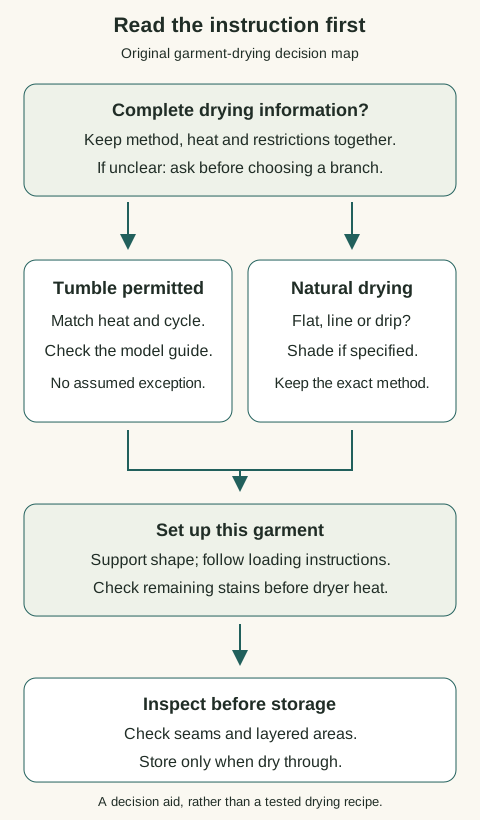
Use the map as a record of a decision, not a replacement for the label. A rack, a dryer program and the available space are practical constraints. They do not supply new care permission. If the arrangement you have cannot meet the instruction, prepare a suitable one or ask the maker about an alternative.
When tumble drying is permitted, match the actual controls
Check the dryer’s model-specific guide for the appropriate program, heat selection, load and any required accessory. ACI describes normal, delicate/low-heat, permanent-press and no-heat cycles as different options. Those descriptions are not proof that every machine uses the same temperatures or control layout.
Keep washing and drying loads separate in your thinking. Items that shared a compatible wash can need different drying arrangements. Remove those that require flat or line drying, and sort the remaining items for compatible dryer instructions. A mesh wash bag has its own directions; garment tumble permission does not establish that the bag is dryer compatible.
Observe the prescribed heat limit without treating it as a demand to use the hottest available setting. Check remaining stains before routine dryer heat or ironing. ACI recommends reassessing washed items with remaining stains instead of drying them, because drying can set stains. Any further treatment still needs garment and product compatibility.
Follow the dryer’s loading instructions and maintain its lint filter as directed. Choose the appropriate endpoint and inspect the garment rather than adding an arbitrary extra hour. This guide cannot identify a fault in a dryer or establish an exact drying time from the fabric name alone.
Flat, line, drip and shade describe different arrangements
For flat drying, support the garment in a flat arrangement that preserves its intended shape. Move a heavy wet knit with suitable support rather than stretching it from one point. If its care instructions call for reshaping, do that gently. A hanger concentrates the wet garment’s weight at hanging points and does not satisfy a flat-dry instruction.
For line drying, arrange the item on an appropriate support as instructed. Check that the placement does not drag a sleeve on a dirty surface or crowd the item into a folded bundle. A drip-drying instruction must remain part of the process; do not replace it with an invented high-spin or wringing step simply to save time.
Keep a shade modifier with the specified natural-drying method. It changes where that method is carried out, not whether the item should lie flat or hang. Direct sunlight is not a universal finishing step for every textile. Consider the actual garment and its instructions when choosing the place.
Give the item an appropriate open arrangement within its permitted method. Inspect seams, cuffs, waistbands and layered areas before folding. ACI advises storing clothes only when fully dry. Airflow, item thickness and room conditions differ, so the number of hours that worked for another item is not a finish test for this one.
Separate heat permission from shrinkage and shape assumptions
The complete garment includes its construction, finish, lining, print, elastic and attachments as well as its fiber composition. The US rule’s section 423.6(c)(3) addresses evidence for component parts together with the garment as a whole. A printed cotton percentage is not a substitute for its finished-item care instructions.
A lower-temperature tumble process can be an allowed choice for a particular item, but it still involves tumbling. Natural drying avoids that drum process while introducing its own support and placement questions. Neither phrase guarantees zero shrinkage, zero stretching or an unchanged finish in every garment.
ACI advises air drying delicates and items prone to shrinking. Apply that general advice alongside the actual permitted arrangement: a flat-dry knit and a line-dry shirt need different setups. Avoid tables that assign every wool, cotton or polyester item one universal drying method. Two garments with similar fibers may have different construction or finishes.
If an item has changed size or shape, record its exact care instructions and what actually happened. Do not assume a second hot cycle will restore it, or that every change can be reversed. For an alteration, new print or conflicting instructions, obtain guidance covering the changed garment before the next clean.
Eight drying decisions with explained answers
These invented cases supply their own label and garment facts. Decide what to do before opening the explanation. They teach instruction reading and setup choices; they are not results of garment tests or a claim that a real product has been assessed.
Case 1
A top carries an ISO/GINETEX square-and-circle symbol with one dot. Your dryer has a Delicate button, but its heat setting is not shown on that button. What should you check?
Show answer and explanation for case 1
Match the mild tumble-drying instruction to the actual machine settings before starting.
In the specified symbol system, one dot indicates reduced thermal action. The name Delicate does not establish the temperature or the complete process on every dryer. Read the model’s guide, including any separate heat selection and loading instructions. Keep the garment’s other restrictions with that setting. If you cannot identify a compatible process, ask for clarification instead of translating the washing temperature into a dryer temperature. This case is a label-reading decision, not a measured test of the machine.
Case 2
A label says do not tumble dry. Someone suggests Air Fluff because it supplies no heat. Does the suggestion resolve the instruction?
Show answer and explanation for case 2
No. A no-heat tumble cycle is still tumble drying.
The prohibition concerns tumble drying, not merely a high-temperature setting. ACI describes Air Fluff/No Heat as a dryer cycle; lowering or removing heat does not stop the item moving in the drum. Look for the garment’s specified natural-drying arrangement. If none is readable, clarify that missing instruction with the maker. Do not infer an exception from the program name, a mesh bag or another garment’s successful cycle. There may be a legitimate item-specific instruction, but this invented case has not supplied one.
Case 3
A heavy wet knit is labelled dry flat. A hanger would use less rack space. Are the two setups equivalent because neither uses a tumble dryer?
Show answer and explanation for case 3
No. Follow the flat-drying instruction and support the garment in its intended shape.
Flat and line drying are distinct methods in the GINETEX guide. A hanging garment carries its wet weight through the hanging points; a flat arrangement provides support along the item. Keep it supported while moving it and arrange it without stretching it to fill the rack. Follow any instruction about removing water or reshaping rather than inventing a wringing step. The example does not prove how much this particular knit would stretch. It shows why the general phrase air dry cannot erase a more specific flat-dry instruction.
Case 4
A shirt has an ISO/GINETEX line-drying symbol with the shade modifier. The sunniest part of the line is currently free. Which parts of the instruction matter?
Show answer and explanation for case 4
Use the indicated line-drying arrangement in the shade.
Keep the natural-drying method and its modifier together. The oblique shade mark does not mean any shaded setup will do, and line drying does not remove the shade requirement. Choose a suitable shaded place and support the shirt as instructed. This is not a recommendation to dry every textile in direct sunlight, nor a promise about a measured reduction in fading. If the item also has a finish or attachment with extra directions, retain those restrictions. The actual complete label remains the basis for the choice.
Case 5
Your ISO/GINETEX chart calls a two-dot tumble symbol normal. A second chart describes three heat levels. Can you rename the two-dot symbol medium without checking the system?
Show answer and explanation for case 5
No. Identify the symbol system instead of merging the two charts.
GINETEX’s ISO 3758:2023 overview distinguishes mild and normal tumble processes. ACI’s fabric-care guide also lists low, medium and high drying settings, reflecting that a reader may encounter a different chart. These lists should not be mixed into a single unqualified dot rule. Use the guide that matches the garment and keep any written directions. If the source of a symbol is uncertain, ask the maker to translate it. Do not create a temperature instruction by averaging charts or assuming every appliance uses the same program names.
Case 6
A washable shirt permits an appropriate tumble process, but a deodorant mark remains after washing. Should the normal laundry routine continue straight into the dryer?
Show answer and explanation for case 6
Reassess the remaining mark before routine dryer heat or ironing.
ACI recommends checking wet washed items for stains and treating remaining marks again rather than drying them, because drying can set stains. That does not authorize repeated strong treatment of any shirt: the garment’s condition and the product directions still determine the next step. Distinguish residue, discoloration and damage, and stop escalating if the material is being harmed. A permitted drying method is one condition, while a stain check is another. Use the separate deodorant guide for a compatible treatment; this drying worksheet does not supply a new chemical recipe.
Case 7
A newly decorated cotton shirt has an old tag permitting tumble drying. The decorator’s added instructions say dry flat. Does the cotton content settle the conflict?
Show answer and explanation for case 7
No. Obtain a compatible complete instruction for the altered garment.
The outer fiber name does not describe every finish, print, lining or attachment. The US rule’s evidence provision addresses component parts together with the garment as a whole. Here the item changed after the original care information was issued, and the instructions supplied in the case conflict. Explain the alteration to the maker or decorator and ask how to care for the finished item. Do not combine one source’s wash instruction with another source’s dryer setting as though they were tested together. Keeping it out of the routine load while asking is a concrete next step.
Case 8
An item labelled dry flat is damp inside a thick seam while its surface feels dry. Can it be folded into a closed drawer now?
Show answer and explanation for case 8
Continue the permitted drying arrangement until the item is dry through before storage.
ACI says to fold and store clothes only when fully dry. Inspect places that can feel different from the broad surface, such as seams, cuffs and layered areas. Arrange the item within its prescribed flat-drying method so the drying surface is not a compressed bundle, and follow any instructions about turning or support. A particular time on a timer is not evidence that this item has finished drying. The example supplies no universal number of hours and does not diagnose a mold or appliance problem. Its final check is the garment’s actual condition.
Download a drying decision sheet for the next load
Download the label-feature table, eight cases with answers and blank drying record. Write the exact drying instruction before translating it into a machine setting or rack arrangement. Keep shade, drip and other restrictions attached to the method.
Item and version:
Complete drying instruction:
Symbol system or maker translation:
Tumble permission and heat/process limit:
Natural-drying method and shade requirement:
Actual appliance setting or support:
Remaining stain or altered component:
Unresolved information and who can clarify it:
Condition checked before storage:
The record should leave one usable decision: follow an identified compatible process, prepare the specified support, or obtain a missing instruction. Save the maker’s clarification with the garment details so the next load does not depend on memory of one isolated symbol.
Sources and further reading
- GINETEX: Care Symbols under ISO 3758:2023Drying category, mild/normal tumble processes, separate line/flat/drip methods and shade modifier. Symbol features are described in words; original symbol artwork remains on the source page.
- American Cleaning Institute: Laundry BasicsDryer-cycle categories, garment instructions, stain checks before drying, air drying delicate or shrink-prone items and fully dry storage.
- eCFR: 16 CFR Part 423, Care Labeling RuleSection 423.6: distinct drying instructions, limits of absent alternative warnings, and evidence for components together with the garment as a whole. This US rule is not presented as a worldwide symbol standard.